

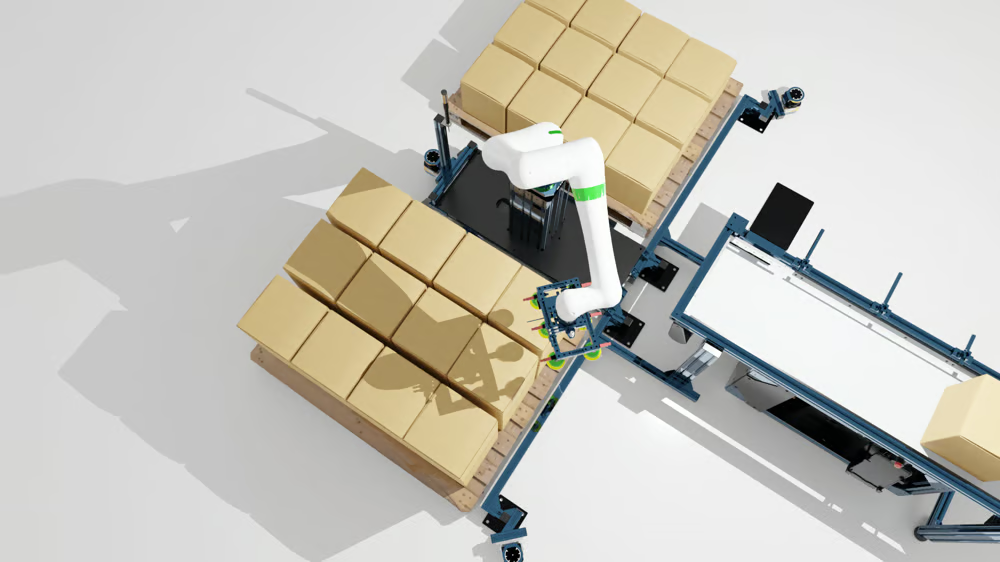
The decision to invest in automatic pallet fillers in Singapore is ultimately a decision about production capability. What a facility can produce, how quickly it can ship, and how safely its workers operate all hinge in part on end-of-line palletising efficiency. Understanding the features that define modern palletising equipment – and the production benefits those features deliver – helps manufacturers make informed choices.
Core Features of Modern Palletising Equipment
Automatic pallet fillers have evolved considerably from the simple mechanical stackers of previous decades. Today’s systems combine precision mechanics, intelligent software, and robust construction to handle demanding production schedules.
Programmable stacking patterns
Programmable stacking patterns allow operators to define exactly how products are arranged on each layer and how layers are oriented relative to one another. Interlocking patterns, where each layer is rotated relative to the one below, create stable pallets that resist shifting during transport. The control system stores hundreds of patterns, enabling fast changeovers between product runs.
Servo-driven motion control
Servo-driven motion control replaces the pneumatic actuators and fixed-speed drives of older machines. Servo systems offer smoother acceleration, more precise positioning, and lower energy consumption. They also reduce mechanical wear, extending the service life of moving components.
Automatic pallet dispensing
Automatic pallet dispensing feeds empty pallets into the stacking position without manual intervention. A magazine holds a stack of pallets – typically 10 to 15 – and releases them one at a time as each completed pallet moves downstream. This eliminates a common bottleneck where operators must manually position pallets between cycles.
Integrated slip-sheet placement
Integrated slip-sheet placement inserts thin sheets of cardboard or plastic between layers for added stability. This feature is particularly valuable when stacking smooth-surfaced cartons or bags that might otherwise slide during handling.
Safety systems include light curtains, area scanners, and interlocked guarding that halt machine operation immediately if a person enters the working zone. These systems comply with international safety standards and Singapore’s Workplace Safety and Health Act.
“The safety features were as important to us as the throughput,” said Ms Jenny Chong, a health and safety coordinator at a food manufacturer in Senoko. “We had two manual handling injuries in the year before installation and none in the 18 months since.”
Production Benefits: Throughput
The most immediately measurable benefit of automated palletising is throughput. Manual stacking imposes a ceiling determined by human physical capacity. Automated pallet handling equipment raises that ceiling dramatically.
A mid-range conventional palletiser handles between 15 and 30 cycles per minute, where each cycle places one product unit or one layer. High-speed systems configured for light; uniform cartons can exceed 40 cycles per minute. For operations where the palletising stage was previously the bottleneck, this increase unlocks capacity across the entire production line.
The speed gains compound when multiple lines feed into a single palletiser. Robotic systems, with their ability to service several infeed conveyors, can consolidate what previously required separate manual stacking crews for each line.
Production Benefits: Consistency
Human stackers vary in their precision. Even experienced workers place products with slight positional differences from one cycle to the next. Over the course of a full pallet, these small variations accumulate into uneven stacks, unstable loads, and occasionally collapsed pallets.
Automatic systems place every unit in the same position, every time. The result is pallets that are square, level, and stable. This consistency has practical downstream effects:
Fewer transport damage claims –
Stable pallets arrive intact, reducing the cost of product replacement and customer dissatisfaction.
Better warehouse utilisation –
Uniform pallets stack predictably in racking systems, maximising the use of expensive warehouse space.
Smoother automated handling –
Facilities using automated guided vehicles or conveyor-based pallet handling rely on consistent pallet dimensions for trouble-free operation.
Production Benefits: Labour Reallocation
Automatic pallet fillers do not simply replace workers – they free workers to perform tasks that add more value. The physical act of lifting and stacking is low-skill and low-value relative to the expertise many warehouse and production workers possess.
With palletising automated, those workers can focus on quality control, line supervision, preventive maintenance, or process improvement. This reallocation improves both workforce productivity and job satisfaction. In Singapore’s competitive labour market, offering workers roles that involve skill and judgement rather than repetitive heavy lifting also supports employee retention.
Production Benefits: Reduced Injury Risk
Musculoskeletal injuries from manual handling remain among the most common workplace incidents in manufacturing and logistics. Each injury carries direct costs – medical treatment, compensation, administrative processing – and indirect costs including lost productivity, hiring temporary replacements, and potential regulatory penalties.
An industrial palletising line eliminates the manual lifting that causes these injuries. The financial case for this benefit alone often justifies the investment, particularly in facilities with a history of handling-related incidents.
Customisation for Specific Requirements
No two production facilities have identical needs. Automatic pallet fillers can be configured to address specific operational requirements:
Multi-line infeed –
A single palletiser serving two or more production lines, reducing equipment costs and floor space requirements.
Mixed-product palletising –
Robotic systems that build pallets containing multiple product types, supporting mixed-order fulfilment.
High-level or low-level infeed –
Depending on the facility layout, products can enter the palletiser at floor level or from an elevated conveyor.
Climate-rated construction –
For cold storage or high-humidity environments, machines built with appropriate materials and sealed components maintain reliability.
Long-Term Return on Investment
The production benefits of automatic palletising are not speculative – they are measurable from day one. Higher throughput, lower waste, reduced injury costs, and improved labour productivity combine to deliver a return on investment typically within 18 to 36 months.
For manufacturers and logistics operators seeking a packaging automation system that strengthens their end-of-line capability, the features of modern palletising equipment translate directly into production gains that compound over years of operation.
For any facility serious about building a more productive and safer operation, automatic pallet fillers in Singapore offer proven features and measurable production benefits that deliver lasting value.
