

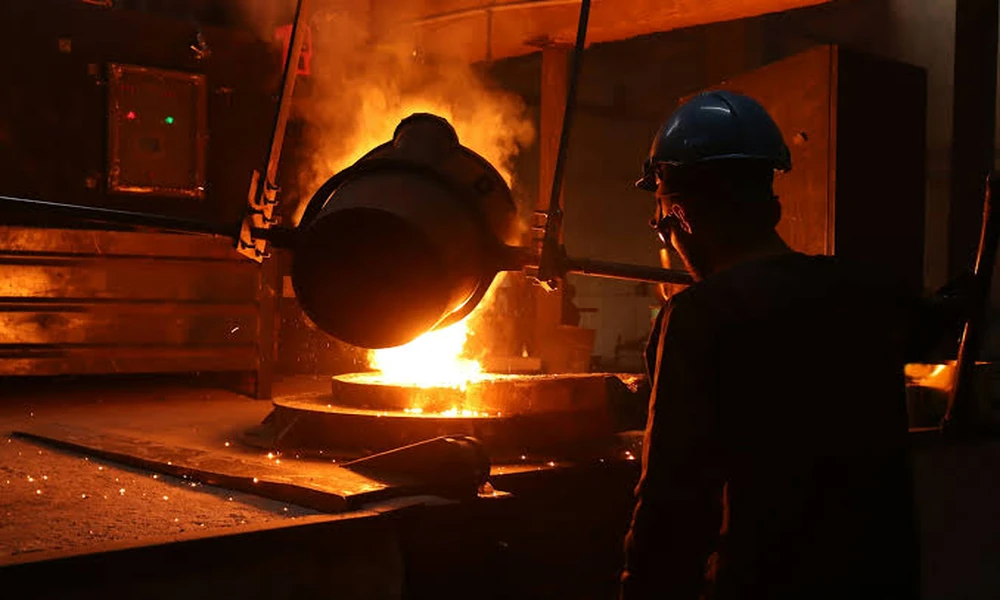
Iron castings are among the oldest and most enduring products of the metalworking industry, and despite decades of competition from aluminum, polymer composites, and fabricated steel alternatives, iron castings retain a dominant position in applications where the combination of high damping capacity, compressive strength, wear resistance, and low cost per kilogram of section that iron provides cannot be matched by any alternative material at comparable cost. An experienced iron castings manufacturer can produce both gray iron and ductile iron castings, the two most important commercial iron casting materials, each with a distinct property profile that determines the applications for which each is preferred.
What is gray iron casting?
Gray iron casting is produced from a cast iron alloy in which the carbon content precipitates during solidification as graphite flakes distributed throughout the iron matrix. The flake graphite morphology gives gray iron its characteristic grey fracture surface and its distinctive combination of properties:
- Excellent machinability: the graphite flakes act as chip breakers during machining, producing easily managed chips and extending cutting tool life significantly beyond what ferritic or pearlitic steel castings allow at comparable hardness
- High vibration damping: the graphite flakes absorb and dissipate vibration energy, which is why gray iron is the standard material for machine tool beds, engine blocks, and the structural bases of precision equipment where vibration damping improves dimensional stability and reduces acoustic noise
- Good thermal conductivity: gray iron conducts heat more effectively than ductile iron or steel, making it the preferred material for brake discs, exhaust manifolds, and other components where heat dissipation is a functional requirement
- Compressive strength: gray iron is significantly stronger in compression than in tension, which suits it to applications where compressive loading dominates, such as machine bases, pressure housings, and the weight-bearing structural elements of industrial machinery
What is ductile iron casting and how does it differ from gray iron?
Ductile iron castings are produced from a cast iron composition in which magnesium is added to the melt before pouring, which causes the carbon to precipitate as spherical nodules rather than the flakes of gray iron. The nodular graphite morphology is the critical difference: spherical nodules do not create the stress concentrations at graphite-matrix interfaces that flakes do, which transforms the material’s tensile and impact properties dramatically relative to gray iron.
The properties that distinguish ductile iron casting from gray iron:
- Tensile strength: ductile iron achieves tensile strengths of 400 to 900 MPa depending on grade and heat treatment, compared to 150 to 350 MPa for gray iron. The strength range of ductile iron overlaps with structural steel, at a lower cost per kilogram
- Ductility and impact resistance: ductile iron withstands plastic deformation and impact loading that would fracture gray iron, which is why ductile iron casting companies supply automotive and heavy equipment components where impact and shock loading are part of the service condition
- Pressure containment: the absence of graphite flake stress concentrators makes ductile iron more suitable than gray iron for pressure-containing applications including pump housings, valve bodies, and hydraulic components
- Fatigue resistance: the spheroidal graphite morphology produces higher fatigue strength than gray iron, which is the reason ductile iron castings manufacturers supply crankshafts, connecting rods, and other components subject to cyclic fatigue loading
What is a cast iron foundry and what services does it provide?
A cast iron foundry is a manufacturing facility that melts iron, pours it into sand or permanent molds, and processes the solidified castings through shakeout, cleaning, heat treatment where required, and secondary operations including machining, surface treatment, and assembly. A full-service cast iron foundry provides:
- Pattern and tooling design: the development of the sand patterns or core boxes that produce the mold geometry for the desired casting, including the draft angles, parting lines, gating system, and risering that produce a sound casting with the required metallurgical quality
- Alloy selection and metallurgical control: the selection and control of the iron composition, inoculant additions, and for ductile iron, the magnesium treatment that produces the specified graphite morphology and mechanical properties
- Non-destructive testing: radiographic, ultrasonic, magnetic particle, and dye penetrant inspection to detect internal and surface discontinuities in castings for critical applications
- Heat treatment: annealing, normalising, quenching and tempering, and austempered ductile iron (ADI) processing to develop the specified mechanical properties
What is a metal casting company and when should manufacturers source from one?
A metal casting company with broad capability across iron and non-ferrous casting processes provides the sourcing flexibility that allows engineering teams to select the right material and process for each component rather than being constrained by a single-material supplier. The decision to source from a full-service industrial iron castings supplier rather than multiple specialist foundries simplifies supplier management, improves communication across a complex bill of materials, and allows the supplier to optimise the manufacturing approach for each component.
